×
Request Free Sample ×

Kindly complete the form below to receive a free sample of this Report

Leading companies partner with us for data-driven Insights

clients tt-cursor
Hero Background

Europe Industrial Iot Platform Market

ID: MRFR/ICT/58791-HCR
200 Pages
Aarti Dhapte
October 2025

Europe Industrial IoT Platform Market Research Report By Application (Predictive Maintenance, Asset Tracking, Remote Monitoring, Supply Chain Management), By Component (Sensor, Connectivity Hardware, Platform Software, Analytics), By Deployment Model (On-Premise, Cloud-Based, Hybrid), By End Use Industry (Manufacturing, Energy and Utilities, Transportation and Logistics, Healthcare) and By Regional (Germany, UK, France, Russia, Italy, Spain, Rest of Europe)- Forecast to 2035

Share:
Download PDF ×

We do not share your information with anyone. However, we may send you emails based on your report interest from time to time. You may contact us at any time to opt-out.

Europe Industrial Iot Platform Market Infographic
Purchase Options

Europe Industrial Iot Platform Market Summary

As per MRFR analysis, the Europe industrial iot-platform market Size was estimated at 8.8 USD Billion in 2024. The Europe industrial iot-platform market is projected to grow from 9.41 USD Billion in 2025 to 18.51 USD Billion by 2035, exhibiting a compound annual growth rate (CAGR) of 7.0% during the forecast period 2025 - 2035.

Key Market Trends & Highlights

The Europe industrial IoT-platform market is experiencing robust growth driven by technological advancements and increasing demand for automation.

  • Germany remains the largest market for industrial IoT platforms, showcasing a strong commitment to digital transformation.
  • The UK is emerging as the fastest-growing region, fueled by innovative startups and government support for IoT initiatives.
  • There is a notable trend towards increased adoption of edge computing, enhancing real-time data processing capabilities.
  • Rising demand for automation solutions and advancements in connectivity technologies are key drivers propelling market growth.

Market Size & Forecast

2024 Market Size 8.8 (USD Billion)
2035 Market Size 18.51 (USD Billion)
CAGR (2025 - 2035) 7.0%

Major Players

Siemens (DE), General Electric (US), Honeywell (US), Cisco (US), IBM (US), Rockwell Automation (US), Schneider Electric (FR), PTC (US), ABB (CH)

Europe Industrial Iot Platform Market Trends

The industrial iot-platform market is currently experiencing a transformative phase, driven by advancements in connectivity and data analytics. As industries increasingly adopt smart technologies, the demand for integrated platforms that facilitate real-time monitoring and control is on the rise. This shift is largely influenced by the need for enhanced operational efficiency and reduced downtime. Moreover, regulatory frameworks across various sectors are evolving, encouraging the adoption of IoT solutions to meet sustainability goals. Consequently, businesses are investing in these platforms to leverage data for informed decision-making and predictive maintenance. In addition, the industrial iot-platform market is witnessing a surge in collaboration among technology providers, manufacturers, and service integrators. This collaborative approach aims to create comprehensive ecosystems that support interoperability and scalability. As organizations seek to harness the full potential of IoT, the emphasis on cybersecurity and data privacy is becoming increasingly pronounced. Stakeholders are prioritizing secure platforms that protect sensitive information while enabling seamless data exchange. Overall, the landscape of the industrial iot-platform market is characterized by innovation, collaboration, and a strong focus on security, positioning it for sustained growth in the coming years.

Increased Adoption of Edge Computing

The trend towards edge computing is reshaping the industrial iot-platform market. By processing data closer to the source, organizations can achieve lower latency and improved response times. This shift allows for real-time analytics and decision-making, which is crucial for industries that rely on immediate data insights. As a result, companies are increasingly integrating edge computing capabilities into their platforms to enhance operational efficiency.

Focus on Interoperability Standards

Interoperability is becoming a critical factor in the industrial iot-platform market. As various devices and systems are deployed, the need for seamless communication between them is paramount. Industry stakeholders are advocating for standardized protocols to ensure compatibility across different platforms. This focus on interoperability not only simplifies integration but also enhances the overall functionality of IoT solutions.

Emphasis on Cybersecurity Measures

With the rise of connected devices, cybersecurity has emerged as a top priority in the industrial iot-platform market. Organizations are increasingly aware of the vulnerabilities associated with IoT deployments. Consequently, there is a growing emphasis on implementing robust security measures to protect data and infrastructure. This trend reflects a broader commitment to safeguarding sensitive information while enabling the benefits of IoT.

Europe Industrial Iot Platform Market Drivers

Growing Focus on Sustainability

Sustainability has become a pivotal concern for industries across Europe, influencing the industrial iot-platform market. Companies are increasingly adopting IoT solutions to monitor and reduce their environmental impact. The integration of IoT platforms allows for better resource management, energy efficiency, and waste reduction. Reports indicate that businesses utilizing IoT technologies can achieve up to 30% reductions in energy consumption. This focus on sustainability not only aligns with regulatory requirements but also enhances corporate reputation. Consequently, the industrial iot-platform market is likely to see growth as organizations prioritize eco-friendly practices and seek innovative solutions to meet sustainability goals.

Government Initiatives and Funding

European governments are actively promoting the adoption of IoT technologies through various initiatives and funding programs. The industrial iot-platform market is likely to gain from these efforts, as public funding can significantly lower the barriers to entry for small and medium-sized enterprises (SMEs). For instance, the European Commission has allocated over €1 billion to support digital transformation projects, including IoT implementations. This financial backing encourages innovation and accelerates the deployment of IoT solutions across various sectors. As a result, the industrial iot-platform market is expected to expand, driven by increased investment in technology and infrastructure.

Increased Data Analytics Capabilities

The industrial iot-platform market is witnessing a transformation driven by enhanced data analytics capabilities. As organizations collect vast amounts of data from connected devices, the ability to analyze and derive actionable insights becomes paramount. Advanced analytics tools, including machine learning and artificial intelligence, are being integrated into IoT platforms, enabling predictive maintenance and improved decision-making. This trend is particularly relevant in sectors such as manufacturing and logistics, where data-driven strategies can lead to significant cost savings and efficiency gains. The industrial iot-platform market is thus poised for growth as companies invest in analytics to harness the full potential of their IoT deployments.

Rising Demand for Automation Solutions

The industrial iot-platform market in Europe experiences a notable surge in demand for automation solutions. Industries are increasingly adopting IoT technologies to enhance operational efficiency and reduce costs. According to recent data, the automation sector is projected to grow at a CAGR of 10% through 2027. This growth is driven by the need for real-time data analytics and predictive maintenance, which are essential for optimizing production processes. As manufacturers seek to remain competitive, the integration of IoT platforms becomes crucial. The industrial iot-platform market is thus positioned to benefit from this trend, as companies invest in smart factories and automated systems to streamline operations.

Advancements in Connectivity Technologies

The industrial iot-platform market in Europe is significantly influenced by advancements in connectivity technologies. The rollout of 5G networks is expected to revolutionize the way devices communicate, enabling faster data transmission and improved reliability. This technological evolution facilitates the deployment of more sophisticated IoT applications, such as real-time monitoring and remote control of industrial processes. As industries increasingly rely on connected devices, the demand for robust IoT platforms is likely to rise. The industrial iot-platform market stands to benefit from these advancements, as companies seek to leverage enhanced connectivity for operational excellence.
Market Segment Insights

By Application: Predictive Maintenance (Largest) vs. Remote Monitoring (Fastest-Growing)

In the application segment, Predictive Maintenance holds the largest market share, reflecting its critical role in enhancing operational efficiency and reducing downtime for industrial processes. This approach allows organizations to anticipate equipment failures before they occur, thus driving substantial operational savings. Other significant applications include Asset Tracking and Supply Chain Management, which are essential for optimizing resources and ensuring efficient logistics. Meanwhile, Remote Monitoring is emerging as the fastest-growing application, fueled by advancements in IoT technologies and the increasing demand for real-time data. As businesses continue to adopt smart technology solutions, the need for continuous monitoring of assets and systems expands, leading to rapid growth in this segment. Factors such as increasing connectivity and the need for operational transparency are propelling its adoption across various industries.

Predictive Maintenance (Dominant) vs. Asset Tracking (Emerging)

Predictive Maintenance is characterized by its ability to leverage data analytics and IoT sensors to predict when equipment is likely to fail, allowing for timely interventions and maintenance strategies. This proactive approach minimizes unplanned downtimes and optimizes maintenance schedules, thereby reducing costs and enhancing productivity in industrial settings. In contrast, Asset Tracking is emerging as a vital tool for businesses aiming to improve visibility and management of their physical assets throughout supply chains. With technologies like RFID and GPS tracking, companies gain real-time insights into asset locations and statuses, supporting better decision-making and resource allocation. Together, these segments complement each other, with Predictive Maintenance focusing on operational reliability and Asset Tracking enhancing logistical efficiency.

By Component: Sensor (Largest) vs. Analytics (Fastest-Growing)

In the component segment of the industrial IoT platform market, sensors dominate, holding the largest market share. Connectivity hardware and platform software are also significant contributors but do not match the extensive reach and critical role sensors play across diverse industries. Analytics, while smaller in share, is gaining traction and rapidly evolving with new technological advancements, showcasing its growing importance. The growth trend within this segment is primarily driven by the increasing need for real-time data monitoring and insights across various sectors. The emphasis on automation and optimized decision-making has propelled investments into analytics solutions that enhance operational efficiency. As industries continue to integrate IoT technologies, the demand for advanced analytics capabilities is expected to accelerate, positioning it as a fast-growing area in the market.

Sensor (Dominant) vs. Analytics (Emerging)

Sensors are a fundamental component of industrial IoT platforms, acting as the backbone by collecting real-time data crucial for monitoring and automation. They are widely utilized across applications such as manufacturing, logistics, and energy management, facilitating enhanced operational performance and safety. In contrast, analytics serves as an emerging component, enabling businesses to interpret the vast amounts of data generated by sensors. The rise of big data technologies and machine learning has given analytics a competitive edge, allowing organizations to extract actionable insights and drive informed decisions. As companies seek to harness the power of data-driven strategies, the emerging analytics component is expected to reshape the competitive landscape of the industrial IoT platform market.

By Deployment Model: Cloud-Based (Largest) vs. On-Premise (Fastest-Growing)

The deployment model segment shows a pronounced distribution, with Cloud-Based solutions commanding the largest share, driven by the increasing demand for scalable, flexible, and cost-effective options. In contrast, On-Premise solutions are experiencing a rapid uptake, largely favored by industries prioritizing data security and control, indicating a robust interest in localized deployments. Growth trends in the deployment model segment reveal a shift towards hybrid models, blending Cloud-Based and On-Premise advantages. Factors such as advancements in cloud technologies, the rise of IoT applications, and stringent data regulations are propelling Cloud-Based solutions forward, while On-Premise solutions are gaining traction for specific industrial applications that necessitate high control over data and infrastructure.

Cloud-Based (Dominant) vs. On-Premise (Emerging)

Cloud-Based solutions are recognized as the dominant force in the deployment model segment, offering unmatched scalability, accessibility, and lower upfront costs, making them particularly attractive for businesses looking to innovate quickly without heavy investment. In contrast, On-Premise solutions are emerging strongly, appealing to sectors that require greater control over their data and compliance with stringent regulations. This juxtaposition highlights a diverse landscape where firms are increasingly adopting hybrid models, leveraging the benefits of both deployment types. This blend allows for enhanced operational flexibility and caters to various organizational needs, marking a significant evolution in how industrial IoT platforms are being deployed and utilized.

By End Use Industry: Manufacturing (Largest) vs. Healthcare (Fastest-Growing)

The Europe industrial iot-platform market exhibits a diverse distribution of market shares across its primary end use industries. Manufacturing stands as the dominant player, leveraging advanced technologies to enhance efficiency and productivity. This segment benefits from widespread adoption of IoT solutions to streamline operations, optimize supply chains, and facilitate real-time data analysis, which solidifies its leading position. In contrast, Healthcare is emerging rapidly, driven by increasing demand for remote monitoring, telemedicine, and smart hospital solutions that integrate IoT for improved patient outcomes. Growth trends in this segment are significantly influenced by technological advancements and the increasing need for automation across various sectors. The Manufacturing segment is likely to continue its stronghold, fueled by ongoing innovations in production processes and smart machinery. On the other hand, the Healthcare segment is expected to witness the fastest growth due to rising investments in digital health technologies and the growing emphasis on personalized care, positioning it as a key player in the future landscape of the industrial IoT platform market.

Manufacturing: Dominant vs. Healthcare: Emerging

The Manufacturing segment in the industrial IoT platform market is characterized by extensive integration of connected devices and systems that enhance operational efficiency and reduce downtime. As industries increasingly turn to smart manufacturing solutions, this segment thrives on innovations such as predictive maintenance and IoT-enabled supply chain management. In contrast, the Healthcare segment is rapidly emerging with innovative IoT applications like remote patient monitoring and intelligent health data management systems. This sector is witnessing an influx of investments aimed at developing technologies that ensure better patient care and streamlined operational processes in healthcare facilities. The growing need for data-driven decision-making in healthcare is positioning it as a vital area for IoT growth, complementing the established dominance of Manufacturing.

Get more detailed insights about Europe Industrial Iot Platform Market

Regional Insights

Germany : Strong Market Share and Innovation

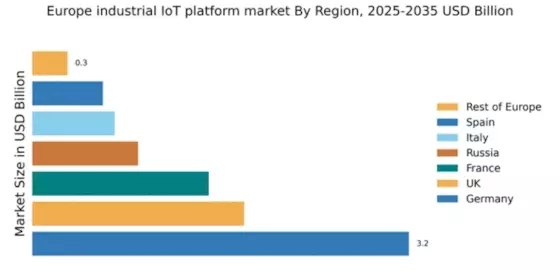
Germany holds a commanding 3.2% market share in the industrial IoT platform sector, driven by robust manufacturing and engineering capabilities. Key growth drivers include the push for Industry 4.0, significant investments in smart factories, and government initiatives promoting digital transformation. The demand for IoT solutions is rising, particularly in automotive and manufacturing sectors, supported by favorable regulatory policies and a strong infrastructure network.

UK : Innovation and Investment in Technology

The UK accounts for 1.8% of the European industrial IoT market, with London and Manchester emerging as key centers for technology innovation. Growth is fueled by increasing investments in smart city projects and a strong focus on sustainability. The UK government has introduced various initiatives to support digital infrastructure, enhancing the demand for IoT platforms across sectors like healthcare and manufacturing. The competitive landscape features major players like Siemens and Cisco, driving innovation.

France : Focus on Digital Transformation

France's industrial IoT market represents 1.5% of the European total, with Paris and Lyon as pivotal cities for technological advancement. The growth is propelled by government policies aimed at fostering innovation and digitalization in manufacturing. Demand for IoT solutions is increasing, particularly in the automotive and aerospace sectors, supported by significant investments in infrastructure. Major players like Schneider Electric are actively enhancing their presence in this dynamic market.

Russia : Investment in Infrastructure Development

Russia holds a 0.9% share of the industrial IoT market, with Moscow and St. Petersburg as key urban centers. The market is driven by increasing investments in industrial modernization and government initiatives aimed at boosting technological adoption. Demand trends indicate a growing interest in IoT applications across energy and manufacturing sectors. The competitive landscape includes both local and international players, with a focus on enhancing operational efficiency through IoT solutions.

Italy : Focus on Manufacturing and Innovation

Italy's industrial IoT market accounts for 0.7% of the European share, with Milan and Turin leading in technological adoption. The growth is supported by government initiatives promoting digital transformation in manufacturing. Demand for IoT platforms is rising, particularly in the textile and automotive industries. The competitive environment features key players like ABB and Siemens, who are investing in local partnerships to enhance their market presence and drive innovation.

Spain : Investment in Digital Infrastructure

Spain represents 0.6% of the industrial IoT market, with Barcelona and Madrid as central hubs for technology development. The market is experiencing growth due to increased investments in smart city initiatives and digital infrastructure. Government policies are encouraging the adoption of IoT solutions across various sectors, including energy and transportation. The competitive landscape includes both local startups and established players like Honeywell, focusing on innovative solutions.

Rest of Europe : Emerging Markets and Innovations

The Rest of Europe accounts for 0.3% of the industrial IoT market, with various countries showing potential for growth. Key drivers include increasing digitalization and government support for technology adoption. Demand trends indicate a rising interest in IoT applications across sectors like agriculture and logistics. The competitive landscape is characterized by a mix of local and international players, each focusing on niche markets and innovative solutions.

Europe Industrial Iot Platform Market Regional Image

Key Players and Competitive Insights

The industrial IoT-platform market in Europe is characterized by a dynamic competitive landscape, driven by rapid technological advancements and increasing demand for automation across various sectors. Key players such as Siemens (DE), Schneider Electric (FR), and ABB (CH) are at the forefront, leveraging their extensive expertise in automation and digital solutions. Siemens (DE) focuses on innovation through its Digital Industries division, which emphasizes the integration of AI and machine learning into its IoT offerings. Schneider Electric (FR) adopts a strategy centered on sustainability and energy efficiency, positioning itself as a leader in smart manufacturing solutions. Meanwhile, ABB (CH) is enhancing its portfolio through strategic partnerships and acquisitions, aiming to expand its capabilities in robotics and automation, thereby shaping a competitive environment that prioritizes technological advancement and operational efficiency.

The market structure appears moderately fragmented, with a mix of established players and emerging startups. Key business tactics include localizing manufacturing to reduce costs and optimize supply chains, which is increasingly vital in a landscape marked by fluctuating global trade dynamics. The collective influence of major companies fosters a competitive atmosphere where innovation and customer-centric solutions are paramount, as firms strive to differentiate themselves in a crowded marketplace.

In October 2025, Siemens (DE) announced a partnership with a leading European automotive manufacturer to develop a next-generation IoT platform aimed at enhancing production efficiency through real-time data analytics. This collaboration underscores Siemens' commitment to driving digital transformation in manufacturing, potentially setting new benchmarks for operational excellence in the sector. The strategic importance of this partnership lies in its potential to streamline processes and reduce downtime, thereby enhancing overall productivity.

In September 2025, Schneider Electric (FR) launched its EcoStruxure platform, which integrates IoT capabilities with a focus on sustainability. This initiative is particularly relevant as industries increasingly prioritize environmental responsibility. By enabling companies to monitor and optimize energy consumption, Schneider Electric positions itself as a key player in the transition towards greener manufacturing practices. The launch signifies a strategic move to align with global sustainability goals, potentially attracting environmentally conscious clients.

In August 2025, ABB (CH) completed the acquisition of a robotics firm specializing in AI-driven automation solutions. This acquisition is likely to enhance ABB's existing capabilities and expand its market reach, particularly in sectors such as logistics and manufacturing. The strategic importance of this move lies in ABB's ability to offer more comprehensive solutions that integrate robotics with IoT, thereby addressing the growing demand for automation in various industries.

As of November 2025, current trends in the industrial IoT-platform market are heavily influenced by digitalization, sustainability, and the integration of AI technologies. Strategic alliances are increasingly shaping the competitive landscape, as companies recognize the value of collaboration in driving innovation. The shift from price-based competition to a focus on technological differentiation and supply chain reliability is evident, suggesting that future competitive dynamics will hinge on the ability to innovate and deliver value-added solutions.

Key Companies in the Europe Industrial Iot Platform Market market include

Industry Developments

The Europe Industrial Internet of Things (IoT) Platform Market has witnessed significant developments in recent months, with companies like SAP, Cisco, and Siemens actively enhancing their offerings. Recent collaborations include Bosch and Honeywell, focusing on smart manufacturing solutions aimed at increasing operational efficiencies. In terms of mergers and acquisitions, GE and Hitachi confirmed their partnership in September 2023, aimed at enhancing digital solutions in the industrial sector, reflecting the ongoing consolidation trend in the market. 

Other notable developments include Dell Technologies' investment in Research and Development to further expand its IoT capabilities announced in October 2023. As of late 2023, market growth figures show an increased valuation for major players due to rising demand for connected devices and data analytics solutions, driven by regulatory pushes for Industry 4.0 in Europe. 

The most substantial growth has been reported since 2021 as companies are rapidly transforming their operational models, adapting to more digital and automated environments, influenced by the current economic landscape and technological advancements. The strong emphasis on sustainability and digital transformation initiatives also remains a focal point among companies like ABB, Oracle, and IBM.

Future Outlook

Europe Industrial Iot Platform Market Future Outlook

The industrial IoT-platform market is projected to grow at a 7.0% CAGR from 2024 to 2035, driven by advancements in connectivity, automation, and data analytics.

New opportunities lie in:

  • Development of predictive maintenance solutions for manufacturing equipment.
  • Integration of AI-driven analytics for real-time decision-making.
  • Expansion of IoT security frameworks to protect industrial data.

By 2035, the market is expected to achieve substantial growth, driven by innovation and strategic investments.

Market Segmentation

Europe Industrial Iot Platform Market Component Outlook

  • Sensor
  • Connectivity Hardware
  • Platform Software
  • Analytics

Europe Industrial Iot Platform Market Application Outlook

  • Predictive Maintenance
  • Asset Tracking
  • Remote Monitoring
  • Supply Chain Management

Europe Industrial Iot Platform Market Deployment Model Outlook

  • On-Premise
  • Cloud-Based
  • Hybrid

Europe Industrial Iot Platform Market End Use Industry Outlook

  • Manufacturing
  • Energy and Utilities
  • Transportation and Logistics
  • Healthcare

Report Scope

MARKET SIZE 2024 8.8(USD Billion)
MARKET SIZE 2025 9.41(USD Billion)
MARKET SIZE 2035 18.51(USD Billion)
COMPOUND ANNUAL GROWTH RATE (CAGR) 7.0% (2024 - 2035)
REPORT COVERAGE Revenue Forecast, Competitive Landscape, Growth Factors, and Trends
BASE YEAR 2024
Market Forecast Period 2025 - 2035
Historical Data 2019 - 2024
Market Forecast Units USD Billion
Key Companies Profiled ["Siemens (DE)", "General Electric (US)", "Honeywell (US)", "Cisco (US)", "IBM (US)", "Rockwell Automation (US)", "Schneider Electric (FR)", "PTC (US)", "ABB (CH)"]
Segments Covered Application, Component, Deployment Model, End Use Industry
Key Market Opportunities Integration of advanced analytics and AI enhances operational efficiency in the industrial iot-platform market.
Key Market Dynamics Rising demand for real-time data analytics drives innovation in the industrial IoT-platform market.
Countries Covered Germany, UK, France, Russia, Italy, Spain, Rest of Europe

Leave a Comment

FAQs

What is the expected market size of the Europe Industrial IoT Platform Market in 2024?

The Europe Industrial IoT Platform Market is expected to be valued at 8.8 USD billion in 2024.

What is the projected market size for the Europe Industrial IoT Platform Market by 2035?

By 2035, the Europe Industrial IoT Platform Market is projected to reach 31.29 USD billion.

What is the expected CAGR for the Europe Industrial IoT Platform Market from 2025 to 2035?

The market is expected to grow at a CAGR of 12.229% from 2025 to 2035.

Which region holds the dominant market share in the Europe Industrial IoT Platform Market in 2024?

Germany holds the dominant market share, valued at 3.52 USD billion in 2024.

What is the expected market value for the UK in the Europe Industrial IoT Platform Market in 2024?

The UK market is expected to be valued at 2.28 USD billion in 2024.

How much is the Predictive Maintenance application segment valued at in 2024?

The Predictive Maintenance application segment is valued at 3.5 USD billion in 2024.

What is the projected market value for Remote Monitoring by 2035?

The Remote Monitoring application segment is projected to reach 5.63 USD billion by 2035.

Who are the major players in the Europe Industrial IoT Platform Market?

Major players include SAP, Cisco, GE, Honeywell, and Siemens among others.

What is the market value for Supply Chain Management in 2024?

In 2024, the Supply Chain Management segment is valued at 1.5 USD billion.

How is the market expected to evolve in the coming years?

The Europe Industrial IoT Platform Market is expected to witness significant growth driven by advancements in technology and increasing demand for automation.

Download Free Sample

Kindly complete the form below to receive a free sample of this Report

Compare Licence

×
Features License Type
Single User Multiuser License Enterprise User
Price $4,950 $5,950 $7,250
Maximum User Access Limit 1 User Upto 10 Users Unrestricted Access Throughout the Organization
Free Customization
Direct Access to Analyst
Deliverable Format
Platform Access
Discount on Next Purchase 10% 15% 15%
Printable Versions